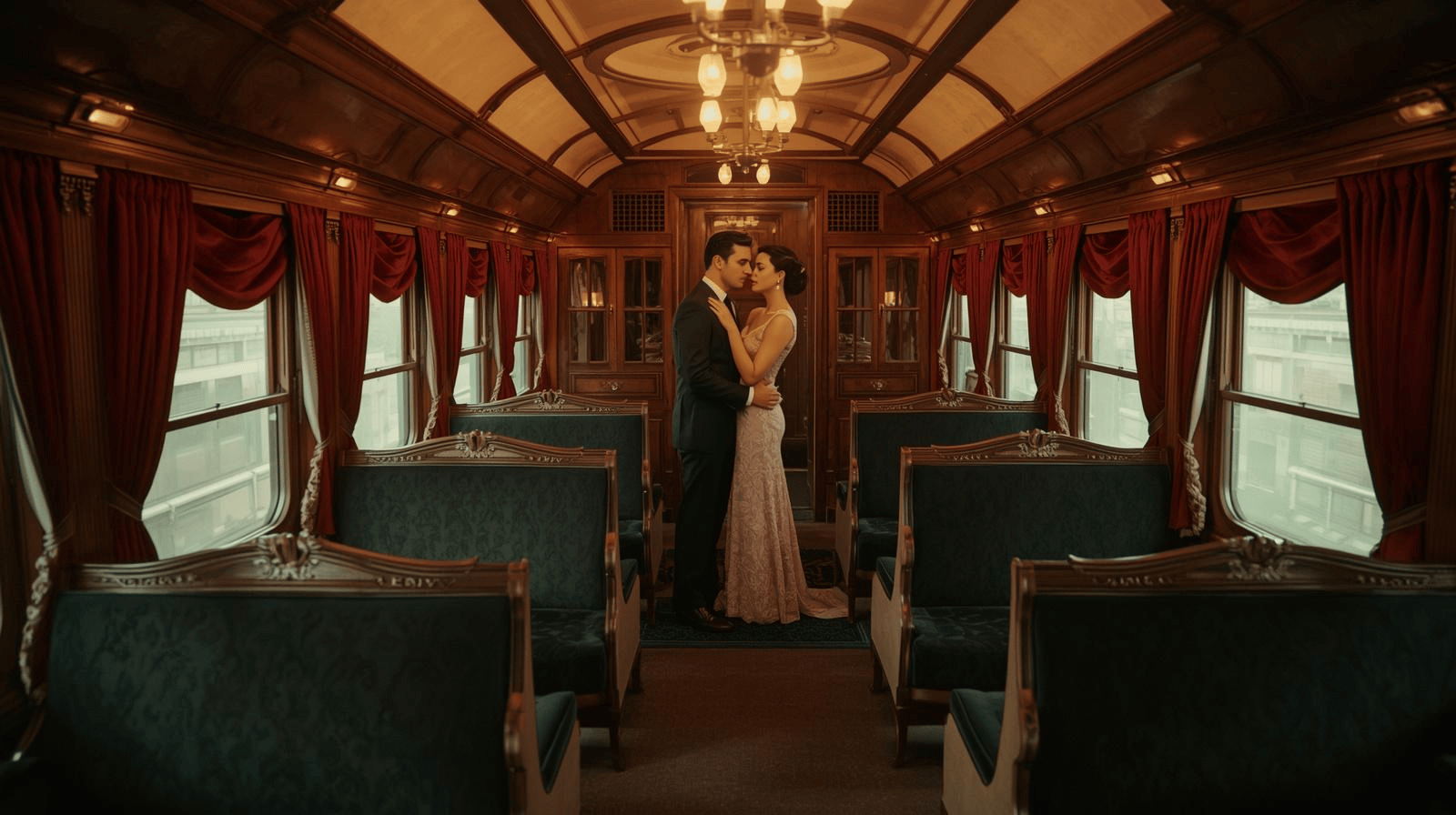
There are quicker ways to cross a country, certainly. There are cheaper ways too. But if you are reading Eldridge & Clements, we suspect you are not always interested in the quickest or the cheapest option. Sometimes what you want is the feeling of travel in its fuller form. A little ritual. A little glamour. A little space in which to look out of the window and remember that arriving is only half the pleasure.
And nowhere understands this better than the great train journey.
The railway has always carried a certain authority. It does not beg for your attention in the way an airport does. It does not demand endless proof of your existence before allowing you to sit down. It simply invites you aboard, offers you a seat, and begins to move. There is confidence in that. There is style in that too.
For the traveller who longs for a slower and more elegant rhythm, vintage rail journeys still offer one of the most civilised ways to see the world.
You may think first, of course, of the great names. The Orient Express still holds an almost mythic place in the imagination, and with good reason. Whether in memory, in fiction, or in its modern incarnations under the Belmond banner, it represents travel as theatre. Polished wood, lacquered surfaces, attentive service, and the sensation that your journey is not merely a transfer, but an occasion. One does not board such a train simply to reach Venice or Paris. One boards it to inhabit, for a little while, a version of Europe in which elegance has not been entirely surrendered.
Belmond, in particular, has understood that modern luxury travellers are not always looking for novelty. Often, they are looking for atmosphere. Its trains are not simply transport wrapped in expensive upholstery. They are experiences designed around mood, ceremony, and memory. The British Pullman, for instance, offers all the right ingredients: vintage carriages, carefully considered interiors, and the sort of lunch or afternoon tea that makes the day feel distinctly set apart from ordinary life. It is not difficult to imagine a better way to surrender an afternoon than in a polished carriage with silver service and the English countryside gliding by outside.
Then there is the Royal Scotsman, another Belmond jewel, which manages to combine Highland scenery with the intimacy of a beautifully run private club. Here, the romance lies not only in the landscape but in the pacing. You are not rushing through Scotland. You are being introduced to it properly. There is tartan, yes, and there is grandeur, but there is also restraint. The train understands that true luxury is often quieter than people expect. A well-made cabin, a considered drink, a view that unfolds without effort — these things have a great deal more staying power than spectacle.
Elsewhere in Europe, there are still routes that carry that same golden-age spirit, even when they are not strictly “vintage” in the museum-piece sense. This is important. A relaxing rail journey need not always involve white gloves and a pianist in the bar car. Sometimes it is enough that the line itself possesses grace.
Take the journey through Switzerland aboard the Glacier Express or the Bernina Express. These are not faux-retro performances of luxury, but they absolutely understand romance. Snow-dusted peaks, deep valleys, tiny villages that appear and vanish like stage scenery, and great panoramic windows that allow the mountains to perform exactly as they should. You are not simply travelling through Switzerland. You are watching it reveal itself with exquisite timing.
The Venice Simplon-Orient-Express, of course, belongs in a category of its own. It has become shorthand for old-world rail glamour, and not without justification. There is a confidence to it that modern travel rarely manages. The cabins, the marquetry, the dining cars, the sense of dressing for dinner because the setting deserves it — all of this speaks to a world in which travel was not stripped down to logistics. It was elevated into ritual. Even if one never boards it, one understands its appeal instantly. It promises not speed, but significance.
And perhaps that is what all the best train journeys share. They make you feel that the journey matters.
This is why so many travellers continue to seek out heritage railways, sleepers, and restored excursion routes. They are not chasing nostalgia for its own sake. They are chasing a quality of experience that modern life has thinned out. They want the compartment, the table lamp, the gently formal service, the chance to sit with a coffee or a martini and watch the weather change over the hills. They want to feel carried, rather than processed.
You may find this on Britain’s heritage lines, where steam and polished brass still lend a sense of occasion to a day out. You may find it on the Jacobite through the Scottish Highlands, where the landscape supplies drama enough for any traveller with a pulse. You may find it on a sleeper route, where the simple pleasure of going to bed in one place and waking in another still feels faintly miraculous. Or you may find it on one of Europe’s more storied luxury trains, where every detail has been arranged to remind you that travel can still be graceful.
What matters is not only the train itself, though that helps enormously. It is the state of mind it permits. Train travel, at its best, allows you to be in motion without feeling hurried. It restores the lost art of transition. You are not abruptly removed from one life and dropped into another. You pass between them. You notice the geography. You feel the weather. You allow a place to introduce itself before you arrive.
That, dear traveller, is a rare luxury now.
So if you have grown tired of the airport shuffle and the clinical efficiency of modern movement, consider the rails again. Choose the carriage with the better view. Choose the route that takes longer. Choose the lunch service. Choose the train that understands wood panelling, good fabric, and the value of being slightly over-dressed for the occasion.
Because some journeys are not improved by haste.
Some are improved by a polished window, a steady rhythm, and the delicious sense that for a few hours at least, the world has agreed to move at your pace.
Leave a Reply