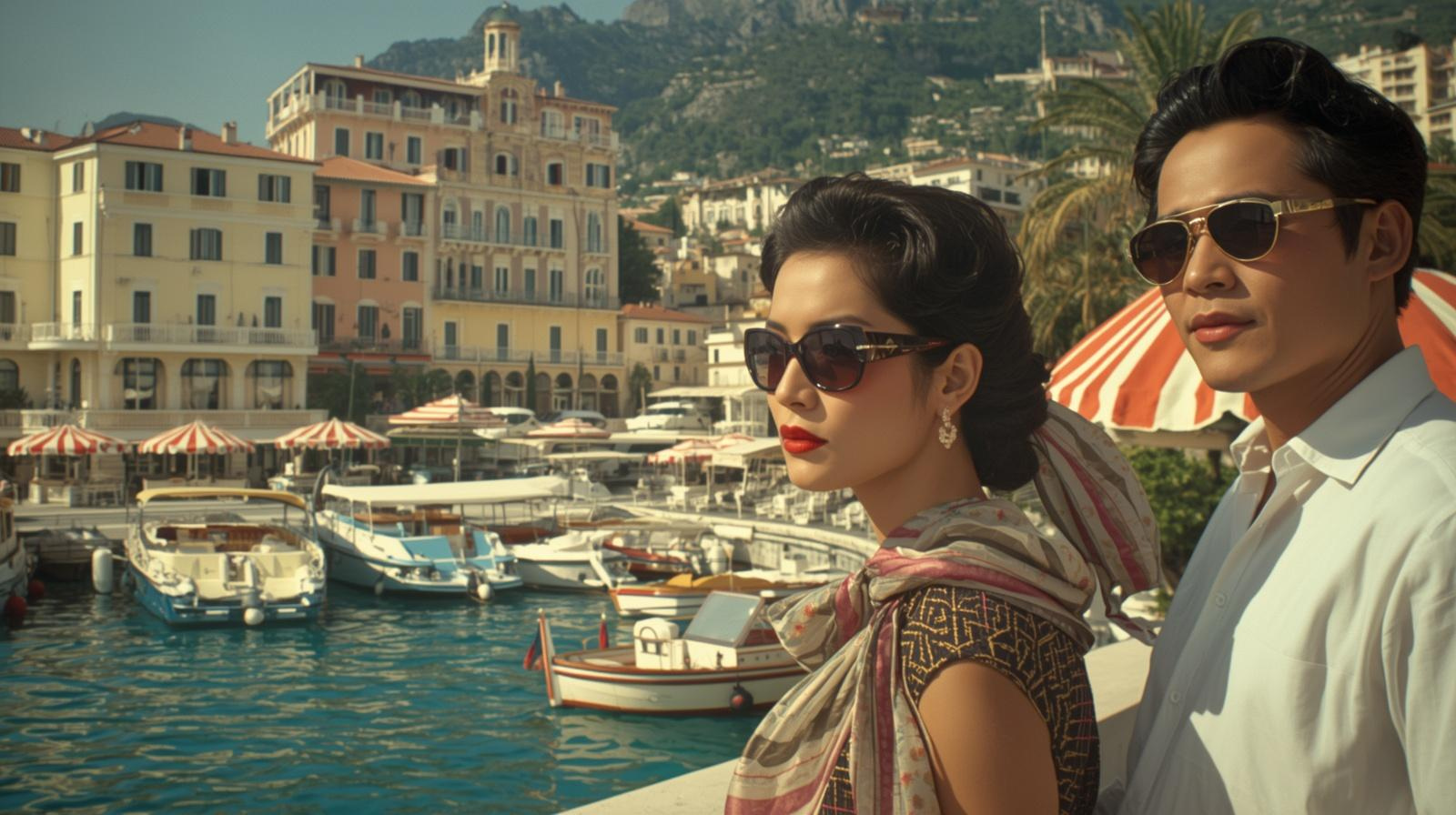
There are certain places in the world that seem to arrive already edited.
The Italian Riviera is one of them.
Even before you begin to describe it, it has already arranged itself into colour, contrast, and composition. The parasols are in place. The façades have decided upon their faded peach, butter yellow, and sea-washed coral. The water catches the light with the confidence of something that knows it has been admired for generations. A white shirt looks better here. So does silence.
If ever there were a coast designed to be seen in Kodachrome, this is surely it.
Not merely photographed, you understand. Interpreted.
Kodachrome did not simply record a scene. It dignified it. It gave warmth to stone, depth to shadow, glamour to sunlight. It turned an ordinary stretch of coast into something cinematic, and the Italian Riviera, with its terraces, coves, hotel awnings, and improbable blues, seems peculiarly suited to that treatment. You do not look at this part of the world and think of digital sharpness. You think of saturated postcards, glossy magazines, and the sort of travel image that once made people pin their hopes to a brochure.
That is the true charm of this coastline. It already belongs to memory, even while you are standing in it.
From Portofino to Santa Margherita Ligure, from Rapallo to the quieter folds of the Ligurian shore, the Riviera possesses that rare visual assurance that allows a traveller to feel not simply present, but beautifully placed. The harbours are full of gentle theatre. Awnings stripe the light. Shutters hold their colour against the heat. Boats drift as if under instruction. Even lunch appears to arrive with a better understanding of proportion.
You may find, if you go there properly, that you begin to see in frames.
A waiter in a white jacket crossing a terrace.
A woman in dark glasses descending stone steps towards the sea.
The particular red of a geranium against pale plaster.
A line of sunbeds in disciplined order.
A polished bar cart catching the late afternoon light.
This is Riviera life at its most persuasive: not loud, not hurried, but arranged with a confidence that modern travel too often lacks. It does not beg to be noticed. It assumes you have eyes.
And perhaps that is why the vintage lens suits it so well.
Kodachrome, and all it now represents in the collective imagination, belongs to an age in which travel was still granted some dignity. People did not simply “do” the Riviera. They arrived for it. They dressed for dinner. They sat on hotel balconies and looked out with concentration. They noticed the shape of a doorway, the depth of a harbour, the quality of evening light on a promenade. Travel was not merely consumed. It was absorbed.
The Italian Riviera still rewards that kind of looking.
It is not just a place for the itinerary-minded traveller, darting between names and recommendations. It is a place for those who understand the value of atmosphere. For those willing to linger over an aperitivo and call that, quite reasonably, part of the day’s achievement. For those who know that the success of a coastal escape lies not in how many places one has covered, but in whether one has allowed a place to colour one’s mood.
And colour, here, is everything.
The Riviera does not traffic in the bleached neutrals that so many modern luxury destinations seem to prefer. It has no interest in disappearing into tasteful beige. It believes in tone. Ochre walls, green shutters, cobalt water, terracotta roofs, lemon awnings, cream linen, navy swimwear, scarlet flowers, silver trays. It is a coast that understands the value of visual punctuation.
This is why it photographs so beautifully in the mind even when no camera is present.
You can imagine the old slides, can you not. A couple leaning on a harbour wall. A small hotel with striped deckchairs arranged on a terrace. A cliffside road curling above the sea. A Martini placed on a table just as the light begins to turn honeyed. These images belong not to nostalgia alone, but to a way of travelling in which beauty was not an accessory. It was part of the reason to go.
That spirit remains.
Not everywhere, of course. No great destination escapes modern intrusion entirely. There are corners of the Riviera now shaped for speed, crowds, and digital proof of presence. But the older glamour has not vanished. You will still find it in the better hotel lounges, in the proportions of an old villa, in the ceremony of a waterside lunch, in the hush that falls over a terrace at dusk when everyone has finally stopped performing and simply begun to enjoy themselves.
These are the moments Eldridge & Clements would urge you to notice.
The Riviera is not asking for haste. It is asking for attention.
It asks you to observe the slope of the coast as it falls into the sea. To notice how the colours become richer towards evening. To choose the longer lunch. To take the side street rather than the obvious one. To sit where you can see both the harbour and the people arriving into it. To understand that true travel charm often lives in sequence rather than spectacle: coffee, promenade, swim, aperitivo, dinner, moonlight, repeat.
This, in the end, is what the Kodachrome Coast offers the modern traveller.
Not just colour, but a way of seeing.
Not just scenery, but composition.
Not just a Riviera escape, but a reminder that certain places are best appreciated through softness, warmth, and a little reverence.
So if you find yourself on the Italian Riviera, do not rush to sharpen it. Do not reduce it to a checklist or flatten it into content. Let it remain slightly cinematic. Let it keep its glow. Let the harbour blur a little at the edges. Let the awnings burn warmer in memory than they did in life. Let the sea hold that impossible shade of blue that no one quite believes until they have seen it.
And above all, allow yourself to look at it as travellers once did: not for proof, but for pleasure.
That is when the Riviera reveals its truest hue.
Leave a Reply